
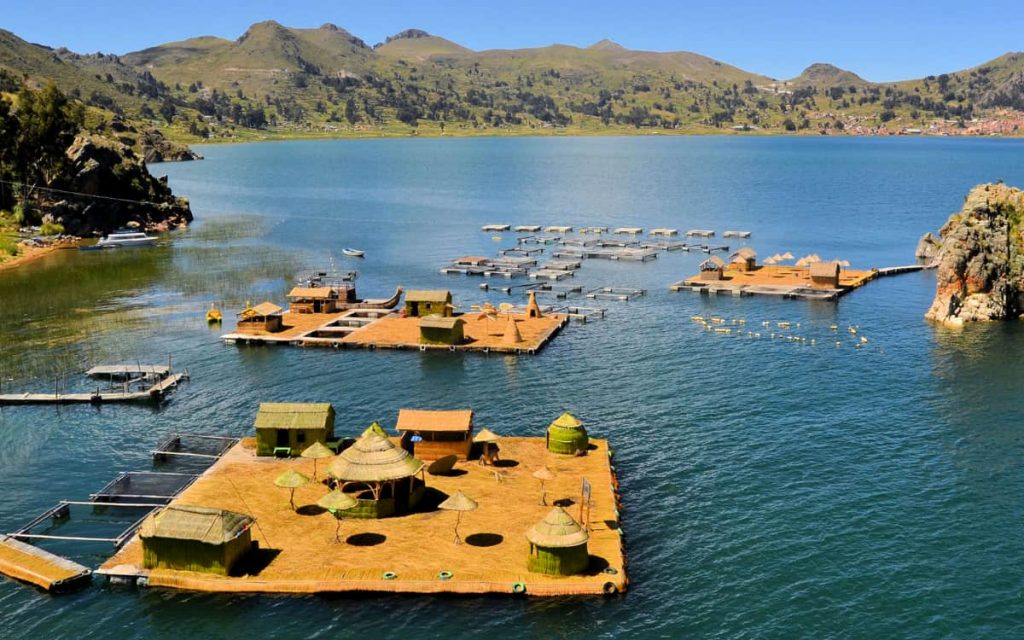
Some small platforms of reed stand out among the intense blue of the Peruvian part of Lake Titicaca, near the bay of Puno. They are the artificial floating islands of the Uros on Lake Titicaca, an ancient people that live in small communities in the middle of the highest navigable lake in the world.
Located at an altitude of 3,800 meters, the lake in which the Uros live is surrounded by mysticism. Titicaca -which means stone puma- is according to legend the place from which Viracocha, the Sun God, emerged, who in turn sent Manco Capac to found the prosperous Inca culture in Cusco.

General information:
Height:
3 815 ms. n. m.
Weather:
min. -8 ° C / max: 19 ° C
Indispensable:
Camera, winter clothes.
Who are the Uros?
Currently it is estimated that around 1,800 people live on the floating islands of the Uros on Lake Titicaca, who are generally related to each other.
The smallest members of the families play in their mothers’ skirts while they weave or serve tourists. They also go to school, which is about half an hour away by boat.
Many times it is the older children who row and take the little ones to class, but other times it is the teacher herself who travels the islands to take them to school, explains José. The first school on the islands was Adventist, founded by Americans, but now they have several more primary education centers.
«The new generations of Uros are changing and many of them are going to study or work abroad,» says the guide. «Perhaps this way of life can become extinct.»
But for now, the men and women of the floating islands continue to come out smiling to receive the visitor with their traditional «kamisaraki» (how are you?) And say goodbye to them from their totora universe while they move away back to Puno or enter the lake.

Other denominations
Uru
Type of indigenous people
Andean
Territorial areas with a traditional presence
Titicaca Lake
Language
Although the Uro people retain a strong cultural identity, for almost a century they no longer speak their original language, Uro, which belonged to the Uru-Chipaya linguistic family (also called Uruquilla). Today only the Chipaya language is spoken of this group of languages, in Bolivian territory.
Currently, the Uro people have Aymara as their predominant mother tongue, followed by Quechua. Many Uros also speak Spanish as their first or second language. In an effort to recover and strengthen their identity traits, today in the Uro people there are initiatives to recover the knowledge of their ancient extinct language, with the support of the Ministry of Culture.
Worldview and ancestral wisdom
The construction of «floating village of Lake Titicaca«, such as lake ships, constitutes one of the ancestral practices of the Uro people, and refers to knowledge that the Uros have transmitted from generation to generation until today. An example of how these knowledge and practices have been the result of their adaptation to the environment and available resources, is that the construction of reed boats has the advantage that it does not contribute to the pollution of the lake like those powered by motor. On the other hand, this practice takes full advantage of the abundant availability of cattail as a raw material (DRC Puno 2012).
Due to the sustained contact that the Uro and Aymara peoples maintained since pre-Hispanic times, it is difficult to distinguish ancestral beliefs whose origins are only related to the Uro people. Perhaps one of the few pieces of evidence available today about the worldview of the Uro people is the discovery of ceramics in Tiahuanaco, whose drawings and decorations represent the moon. It is believed that the moon would have been the main deity of this town for having «illuminated» the Uros in their nocturnal fishing and hunting expeditions (DRC Puno 2012).
Houses and Boats
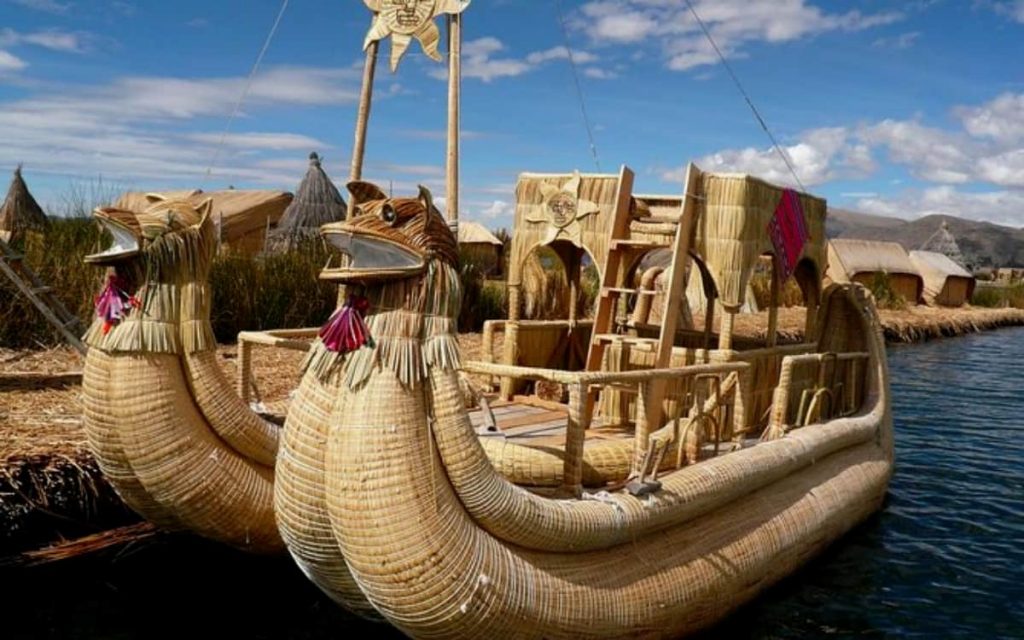
The houses and boats of the inhabitants of the floating islands of the Uros on Lake Titicaca have built from the same cane using a technique similar to that of the islands. They also make handmade items that are sold to tourists visiting the floating village of Lake Titicaca. Around almost every 6 months they have to lift and move their houses so that they can add another layer of reed to the floating island.
Food
When the cattail is pulled to build, part of the root is eaten because it is a rich source of iodine. It is also used to relieve pain, make tea, and cure hangovers.
The inhabitants of Los Uros consume species of fish such as karachi, ispi and pejerrey, as well as trout which are raised in their own cages, right in the middle of the islands where they have installed hatcheries. In addition, they hunt wild birds such as duck and choca for their consumption, however, they also barter with merchants in the districts of Ácora, Puno and Ilave in exchange for potatoes, broad beans, quinoa, rice, sugar and packages of noodles.
They also eat guinea pigs.
Education
On the floating islands on Lake Titicaca, there is a traditional school and a Christian school that are the main sources of education on the islands. As the children grow older and start looking for a university, they are likely to leave the lake and head for the mainland to study in Puno.
How do they build the reed islands of Lake Titicaca?
«It is the men who collect the reeds when they surface in the rainy season,» explains José, one of the tour guides who accompany tourists to visit the Uros islands of Lake Titicaca.
They braid the roots and tie them tightly with string to make blocks. An island of Lake Titicaca floats in about thirty blocks to which is added a layer of dry reed.
Everything is attached with heavy stones in the water that serve as anchors so that the island does not move.
In contact with water, the cattail rots and the gas that emanates from it contributes to flotation. To maintain them, every 20 days a new layer of reeds is added on the surface and the islands are anchored with ropes, stakes and stones that sink to a depth of about three meters, explains the president of one of the communities.
There are approximately 80 Uros islands on the Peruvian side of Lake Titicaca, among the most important are Tupiri, Santa María, Tribuna, Toranipata, Chumi, Paraíso, Kapi, Titino, Tinajero and Negrone.
An island can have a useful life of 30 years. The vast majority of the islands are small, but some even have a soccer field and a school.
On each island, between five and seven families live together, subsisting on hunting and fishing, which they then sell or exchange in the Puno market. Each island has a president and there is a maximum boss for all of them.
Also the houses and some of the boats they use are made with reeds, a plant that they also eat and use as medicine. The rectangular-shaped houses are small, one-piece rooms where the whole family sleeps.
As for the boats, which can have as many as two floors, they take about six months to build and can be used for about seven years. «In 1947, the expedition of the Norwegian explorer Thor Heyerdahl traveled 4,700 miles between Peru and French Polynesia on a raft similar to those built by the Uros,» says José.
In addition, we find handicrafts made with reeds, which are offered by the cheerful inhabitants of this area to visitors to complete the experiential experience of this magical place.
About the use of Totora
The totora is a renewable and indispensable resource for the life of the Uros, because with it they build their islands. The reeds, skillfully woven, also make up the roofs, walls and doors of their homes. With the same material they make the main means of transport between their islands and the mainland: the rafts.
Another very important use of the cattail is that when the stalks are dried they are used as firewood for their kitchens, fulfilling the function of fuel. With the arrival of more tourism, they began to make beautiful totora handicrafts, which they sell to help their economy.
In addition, they use it as food, since when the bark is removed, a white, fibrous substance remains, practically without taste, but also used as a supplement to their diet.
History of the floating islands of Lake Titicaca
The origins of the Uro people date back to times before the Incas. According to several researchers, the Uros would be a group of the oldest settlers of the Collao plateau.
El Collao is a region that has undergone successive occupations. Between the 1st and 13th centuries it was the tiawanaku who would have inhabited this area. After the disappearance of the tiawanaku, this area was occupied by several Aymara kingdoms, who would have subdued the original settlers, including the Uros, cornering them to a more proper habitat: the lake, the Desaguadero river and its tributaries, and incorporating others to the Aymara agricultural society (Prada 2008).
After the conquest of Collao, by the Incas, the Uros would have been incorporated into the empire through the payment of taxes, which were fish and the manufacture of straw pouches (Prada 2008, Delgadillo 1998).
Adapted to their natural environment, the ancient Uros had as their main activity the fishing and hunting of birds that inhabit the lake, also developing knowledge and practices related to the management of the totora that they use to date for the making of the «islands floating”, houses and warehouses of the same material.
The first colonial reports that refer to this town date back to the 1570s, during the government of Viceroy Francisco de Toledo. After a trip to the province of Charcas, today part of Bolivian territory, Toledo would report the existence of two ethnic groups in Collao: Aymara and Uro.
The proportion of Aymara and Uros in the Charcas and Cusco parcels was estimated at 3 to 1, at that time accounting for the Aymara predominance.
According to Therese Bouysse-Cassagne (1987), this relationship would continue 40 years later. By this time, there is also a uro population that speaks Uroquilla, Puquina, Aymara and Quechua interchangeably. This means that, as a group, the uro condense in some way the various historical stages that the area has gone through: the first, the most distant, would be the uroquilla-speaking uros; the second, the Puquina-speaking Uros, who represent the Tiawanaku influence; and the third the predominance of the Aymara group (Bouysse-Cassagne1987).
In the last decades the tourism sector began to grow in Puno and with this the Uros began to become visible again as an original people. Although the Uros currently do not have their own language, since most of them speak Aymara as their mother tongue, it is known that the population of the Uros Chulluni Peasant Community preserved uro as their native language until the 1920s (DRC Puno 2012).
In the mid-1980s, the Puno region was affected by a series of floods. These floods affected the uro population that inhabited some floating islands, as they resulted in the displacement of a significant number of islands from the northern part to the southern part of the Titicaca Natural Reserve.
How to get to the floating islands of Lake Titicaca in South América?
Lima-Puno:
By bus or car: approximately 21 hours
Puno-Uros:
Boat: 20 min approximately
What to see and do in the floating islands on Lake Titicaca in Puno?
Do you want to visit the floating islands on Lake Titicaca on your next Perú tour package? What a good idea!
So you can discover the traditional way of life of one of the oldest cultures in America and the manufacturing process of these artificial islands built in reeds.
The Uros floating islands are usually visited with a tour of Lake Titicaca from Puno, often with the island of Taquile in one day, or in two days with the islands of Taquile and Amantaní.
How is the visit to the Uros?
The islands are reached after about 20 minutes by boat from the port of Puno.
You cannot choose which island you are going to visit because tourism works in rotation so that all families receive travelers equally.
They welcome you with songs, then invite the group to sit in a circle to hear how the islands are built.
You can dress in their traditional clothes and they invite you to buy handicraft souvenirs, including various objects in reed.
I suggest you take a short tour of the island to see everything that has been built (houses, watchtowers, etc.).
They also propose to take a tour on their reed boat for 10 soles, but it is optional.
The visit continues to a larger island where you can get your passport stamped (as in Machu Picchu!). With the «floating islands of Lake Titicaca in Puno» stamp for 2 soles. Go to the Uros Islands on your own
The advantage of going to the Uros on your own is that it is cheaper, since you buy the ticket directly at the port.
The boat makes the round trip between Puno and Los Uros every day from 6 a.m. to 4:30 p.m.
The trip lasts 30 minutes and costs 15 soles. You also have to pay an entry to the islands of 2.50 soles.
Once there, if you want to do the boat tour in totora that they always propose, you have to pay 10 soles (optional).
My advice
If after the Uros you want to go to Taquile Island without going through an agency, you can simply take the boat in Puno that goes to Taquile because it always makes a stop at the Uros Islands. But beware, there is only one departure per day at 7:30 am!
Go to the Uros islands with a tour
The advantage of going with an agency is that you can make the most of your time.
Tours to the floating islands of Lake Titicaca in South América are done in half a day, 1 day or 2 days depending on what is included in the program.
I present you the best guided tours of Perú with pick up at your hotel in Puno. They are in high demand, so be sure to book in advance to ensure availability.
Uros Island (1/2 day)
This is the shortest tour (3 hours) that only includes the visit of the Uros and is perfect if you have very little time.
Uros Island and Taquile Island (1 day)
If you have a little more time, I recommend this option, which is much better since it also includes a visit to the island of Taquile with a short walk along its trails and lunch on the island.
Isla de los Uros, Amantaní and Taquile with night in a family’s house (2 days)
The two-day tour is the most complete, because it allows you to see 3 essential places of Lake Titicaca.
– The first day, you will visit the floating islands on Lake Titicaca, then you will discover the island of Amantaní and you will meet the family who will welcome you to their home for the night.
You can go up to the Pachatata or Pachamama viewpoint to admire the sunset over Titicaca.
Then you will have dinner with the family before participating in a local party in the community and sleeping on the island.
– The second day, after breakfast, you will go to the island of Taquile.
You will have time to visit the island whose textile art has been declared a World Heritage Site, and you will have lunch before returning to Puno around 5-6pm.
Uros Island tour by kayak, Amantaní and Taquile with night in Lake Tititcaca (2 days)
This is a two-day excursion to Titicaca that follows the same program as the previous one, with the difference that the journey from Puno to Los Uros is done by kayak!
Therefore, it is an interesting option if you are an active traveler and want to add an original activity to your visit.
Sleep on the floating islands on Lake Titicaca Perú
There are also experiential tourism programs in the Uros, for example in Khantati. You can ask to add this experience in your all inclusive vacation packages to Perú.
It allows you to sleep in a house made of cattails with basic but comfortable comfort, with electricity powered by solar panels.

It is the opportunity to converse with the inhabitants, walk around the lake to enjoy the scenery and fish with them.
Below, we detail approximate prices for the visit:
- Entrance to the Island: US $ 1.5
- Boat transportation cost: US $ 3
- Lodging cost: US $ 52 per person per night. Includes food and activities
Our best vacation packages to Perú include all these expenses in the price, and you will not have to worry about anything.
A less touristy alternative: the Uros Titinos Islands
The Titinos Islands are also floating islands built by the Uros, but they receive fewer tourists.
The reason is very simple: they are located a little further from Puno than the «classic» floating islands, so they are not usually included in the tours.
In reality the experience is more or less the same, since they introduce you to the process of building the islands and the way of life of the Uros.
The advantage is that you can easily combine a visit to the Titinos Islands with a night in Llachón or any other community on the Capachica Peninsula, since they are located right in front of it.
Is it really worth the visit?
Yes, the visit to the floating islands on Lake Titicaca is worth it because it is quite interesting to discover the entire manufacturing process of these islands, a technique that has been passed down through the centuries!
So if you are planning a 15 Days travel itinerary to Perú, you must include a visit to the floating islands of the Uros in Lake Titicaca.
What to take to the Uros?
Below we list some items that you should take if you visit the floating islands on Lake Titicaca and in general you should take with you throughout any Perú & Machu Picchu vacation packages.
- Cash in soles (they do not accept cards and there are no ATMs)
- Water and snacks because it is a long day of visit
- A good sunscreen, sunglasses and a hat because the sun is very strong on Titicaca.
- Warm clothes because it is cold on the boat and also on the islands (if you spend the night with a family).
- Also prepare something to distract yourself if you take the one or two day trip because there is no internet.
Will I feel the effects of the altitude?
The Uros are 3812m high so you can feel the symptoms of altitude sickness if you don’t give your body enough time to adapt. Plus the boat trip can amplify nausea.
Some tips to acclimatize to the altitude:
- Rest: it always helps me a lot to take a nap, it is the most efficient
- Avoid any physical effort on the first day (but if you come from Cusco, don’t worry, you’ll be fine)
- Eat light
- Drink a lot of water
- Avoid alcohol and cigarettes
You should also keep these tips in mind if you are going to travel the Inca Trail during one of our best Machu Picchu hiking tours, such as the 11 Days hiking package to Machu Picchu.
0 comentarios